Mad World, Green World
We all know how to structure a story, right? Take a character, plop them down on the bottom of a steep incline and, (aargh!) as they climb, throw obstacle after obstacle at them, one after another, until they (finally - whew!) reach the summit (ta-da!), and fall into a lovely (no loose ends) denouement.
Unless, of course, that’s not the way to do it. There is another theory of structure - that of Mad World and Green World. I believe it was born with Frye (and those of you who know more or better, go ahead, educate us). It basically goes like this: Green World is what the character wants; it is harmony; it is the good place. Mad World is the character’s personal hell, it is destabilization; it is the bad place.
Do a few permutations and we find that there are four different stories possible: The straight descent from Green to Mad, the straight ascent from Mad to Green, and either the journey from Mad to Green and back to Mad, or from Green to Mad to Green again.
Confused? Think Wizard of Oz.
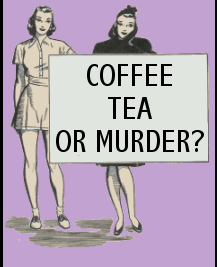
Or better yet, think of the idea tossed around at every mystery convention - that the reason we love mystery is that it takes a bad situation (Murder typically, but see the comments on last Thursday’s post here if you challenge that assumption) and, by the mystery’s solution, puts the world back into order. Usually a Green to Mad to Green situation. Delve into noir and it’s usually Mad to Green to Mad.
But my favorite characters tend to be experts at arriving in a Green world that’s gone slightly Mad, and not leaving until things are truly verdant again.
Think Poirot and his sirop de cassis interrupted by a letter from a peer of the realm. Think Amelia Peabody’s and Emerson’s whiskey and soda interrupted by Sethos in God-knows-what-disguise this time. Think any of the Good Girls’ characters arriving on the scene of what they thought was just another day-in-the-life only to find themselves embroiled in yet another mystery.
Examples from your favorites? Other theories to offer?